
BVRio’s Fishing for Litter programme wins 2026 SEIM Integrating Actions Award
BVRio’s Fishing for Litter programme has won the 2026 SEIM Integrating Actions Award, presented by the Special Secretariat for Metropolitan Integration (SEIM) of the Rio de Janeiro City Government. The award was presented on 25 September during the seminar “Waste Management: Challenges and Solutions for Metropolitan Cities”, which brought together public officials, experts and civil society organisations.
Established by SEIM, the award recognises initiatives that have already been implemented and demonstrated tangible results, social relevance, community engagement and the potential to drive meaningful change.
Operating in Guanabara Bay since 2021, Fishing for Litter pays small-scale fishers to remove waste from mangroves, shallow waters, islands and other hard-to-reach areas. The programme has already recovered more than 600 tonnes of waste from Guanabara Bay and engaged around 100 fishers, both women and men. It combines income generation, traditional knowledge, waste traceability through the KOLEKT app, and collaboration with recycling cooperatives and other stakeholders across the recycling value chain.
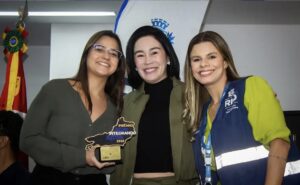
Juliana Miranda (left) received the prize
For Juliana Miranda, Circular Economy Analyst at BVRio, who represented the organisation at the seminar, the recognition reinforces the need for greater cooperation across Guanabara Bay:
“The pollution affecting Guanabara Bay is a metropolitan challenge. To build on the impact we have already achieved through Fishing for Litter, we need to strengthen connections between fishers, recycling cooperatives, public authorities, universities, businesses and other initiatives working in the area. This integration is what can turn individual efforts into a solution at scale for the Bay.”
A metropolitan challenge calls for integrated solutions
The SEIM team also visited the programme in September to observe the fishers’ work first-hand and produce a series of videos about the initiative, which were shared on SEIM’s Instagram account.
The visit helped highlight the links between waste recovery in Guanabara Bay and other solutions being developed across the metropolitan region, including new ways of recovering value from materials that are difficult to recycle.
For Cynthia Felix, Special Secretary for Metropolitan Integration at the Rio de Janeiro City Government, this collaboration is essential:
“This is a metropolitan issue that requires dialogue, cooperation and shared responsibility. SEIM’s role is precisely to foster this integration, bringing municipalities, public administrations, universities, institutions and initiatives together to turn knowledge into concrete action. Integrated governance is successful governance.”
This approach is already guiding the expansion of Fishing for Litter. Alongside its collaboration with recycling cooperatives across the metropolitan region, BVRio is working with NIDES/UFRJ and IVIG/UFRJ to explore alternatives for hard-to-recover materials, including pyrolysis, a technology that can convert plastic waste and residual biomass into pyrolysis oil, combustible gases and biochar.
In a further development, BVRio has entered into a technical cooperation agreement with the Rio de Janeiro State Environment Institute (INEA) to install the first river barrier managed by the Fishing for Litter programme. This will extend the programme’s work beyond removing waste already accumulated in the Bay to intercepting it before it reaches the marine environment.
In 2026, Fishing for Litter was also officially endorsed as a UN Ocean Decade Project, recognising its contribution to turning fishers’ knowledge and field data into evidence that can inform coastal management and efforts to tackle marine pollution.
As part of this new phase, the programme has also joined SmartNet (Sustainability of Marine Ecosystems through Global Knowledge Networks), strengthening its links with international marine science and cooperation networks.
The programme’s scientific foundations will also be strengthened through support from FAPERJ’s Researcher in Business Programme (Pesquisador na Empresa), which aims to connect researchers holding master’s and doctoral degrees with organisations developing research, innovation and solutions with socio-environmental impact. Through this initiative, two researchers will work on developing knowledge and protocols for coastal reverse logistics within Fishing for Litter.
The award reinforces a key priority for the programme’s next phase: bringing together initiatives, institutions and resources to scale up its impact across Guanabara Bay.
Does your organisation work in Guanabara Bay, or could it contribute solutions, research, infrastructure, recycling expertise or funding? Contact the BVRio team at info@bvrio.org to explore partnership opportunities.


