
BVRio’s Fishing for Litter endorsed by the UN Ocean Decade
 BVRio’s Fishing for Litter programme has been officially endorsed as a Decade Project under the United Nations Decade of Ocean Science for Sustainable Development 2021–2030.
The endorsement was granted by the Executive Secretary of UNESCO’s Intergovernmental Oceanographic Commission following a formal review of the project’s contribution to the Ocean Decade’s vision of delivering ‘the science we need for the ocean we want.’ The Ocean Decade provides a global framework through which scientists, governments, civil society, communities and the private sector work together to develop and apply knowledge for a healthier and more sustainable ocean.
Fishing for Litter’s endorsement acknowledges its potential to transform the experience and traditional ecological knowledge of artisanal fishers into traceable data, practical evidence and solutions that can inform coastal management and marine pollution policies.
“This endorsement affirms that community-led marine litter recovery can do much more than waste removal. Our programme combines fishers’ knowledge with robust traceability, allowing each collection to generate evidence for better coastal management while creating paid environmental work for communities on the frontline of marine pollution,” said Pedro Succar, BVRio Circular Economy Specialist.
The timing is particularly significant for a Rio-based programme, as the 2027 Ocean Decade Conference will be held in Rio de Janeiro, bringing the global ocean community to the city at the heart of Fishing for Litter’s work.
It also places the programme within an international community of endorsed Decade Actions, opening new opportunities for scientific cooperation, knowledge-sharing, capacity development and the replication of its model in other coastal regions.
Connecting local knowledge with a global ocean network
Fishing for Litter’s host programme within the Ocean Decade is the SmartNet – Sustainability of Marine Ecosystems through global knowledge networks. Led by the International Council for the Exploration of the Sea and the North Pacific Marine Science Organization, SmartNet connects ocean science organisations and partners around the world.
SmartNet has invited BVRio and its community partners to contribute to the Ocean We Want Survey, a global initiative led by Professor Mitsutaku Makino of the University of Tokyo.
“As we enter the second half of the UN Decade of Ocean Science for Sustainable Development (UNDOS), the time has come to discuss what we have achieved so far and the challenges that remain. We are greatly encouraged by the participation of Brazilian researchers in our global survey project.” Mitsutaku MAKINO, Professor of the University of Tokyo and President of Ocean Policy Research Institute of the Sasakawa Peace Foundation.
The survey explores how people in different countries and regions understand the ocean they want and the issues that should be prioritised during the Ocean Decade. Following pilot studies in Australia, France, Japan and the United States, the research team is now preparing to extend the survey to Brazil, with support from BVRio in connecting with Brazilian communities.
“BVRio’s strong connection with local communities creates an important opportunity to extend the Ocean We Want Survey to Brazil and bring Brazilian perspectives into this global initiative,” said Dr Sanae Chiba, SmartNet co-chair, Deputy Executive Secretary, North Pacific Marine Science Organisation (PICES).
Advancing research and building the evidence to scale
BVRio’s Fishing for Litter programme was selected for funding under the Researcher in Enterprise programme of the Foundation for Research Support of the State of Rio de Janeiro (FAPERJ). As a result, two researchers will carry out applied research for the project, strengthening its evidence base and developing approaches to coastal reverse logistics. Their work will support the objectives of Fishing for Litter as an endorsed UN Ocean Decade Project.
“The support from FAPERJ will allow us to strengthen the programme’s scientific foundations and translate field experience into stronger protocols for coastal reverse logistics and blue carbon. This will help us improve the model in Guanabara Bay and support its replication elsewhere,” said Maria Accioly, BVRio Circular Economy Specialist.
Through 2030, BVRio and its partners will continue working to:
- remove legacy waste from sensitive marine and coastal ecosystems
- strengthen the technical and organisational capacity of participating fishing communities
- improve the accessibility and use of marine litter data
- connect community knowledge with scientific research and public policy
- expand the model to other coastal communities facing similar challenges
Recognition in Guanabara Bay’s metropolitan region
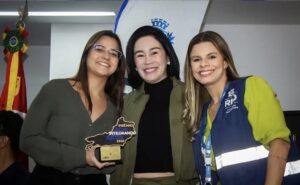
Photo: SEIM/Instagram
On Friday, 25 September, Fishing for Litter received the Integrating Actions Award at the seminar ‘Waste Management: Challenges and Solutions for Metropolitan Cities’, organised by Rio de Janeiro’s Special Secretariat for Metropolitan Integration (SEIM).
BVRio’s Circular Economy Analyst Juliana Miranda received the award and joined public officials and specialists to discuss a challenge that crosses municipal boundaries. The wider hydrographic region encompassing Guanabara Bay covers all or part of 17 municipalities. Waste carried through its waterways eventually reaches coastal ecosystems and the fishing communities that depend on them. The award recognises the artisanal fishers and partners working in the bay to recover that waste, document what they find and help restore these ecosystems.
Learn more about BVRio’s Fishing for Litter
About the UN Decade of Ocean Science for Sustainable Development
Proclaimed in 2017 by the United Nations General Assembly, the UN Decade of Ocean Science for Sustainable Development (2021-2030) (‘the Ocean Decade’) seeks to stimulate ocean science and knowledge generation to reverse the decline of the state of the ocean system and catalyse new opportunities for sustainable development of this massive marine ecosystem. The vision of the Ocean Decade is ‘the science we need for the ocean we want’. The Ocean Decade provides a convening framework for scientists and stakeholders from diverse sectors to develop the scientific knowledge and the partnerships needed to accelerate and harness advances in ocean science to achieve a better understanding of the ocean system, and deliver science-based solutions to achieve the 2030 Agenda. The UN General Assembly mandated the Intergovernmental Oceanographic Commission (IOC) of UNESCO to coordinate the preparations and implementation of the Decade.
#OceanDecade


